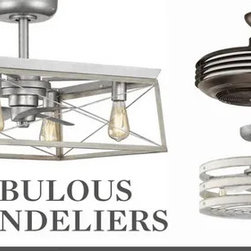


#Are fandeliers as good as ceiling fans?#
You’re standing under a pretty “chandelier-looking” fixture that also spins, and you’re wondering: is it actually going to cool you the way a real ceiling fan does? You’re not alone. In plain terms, a fandelier can be “as good” as a ceiling fan for certain rooms and certain expectations—but it can also disappoint you fast if you buy the wrong type for the wrong space. Here’s the friendly, real-life answer, with clear ways to decide in minutes (and avoid the classic regret purchase).
Key takeaway: If your priority is airflow and comfort, a traditional ceiling fan usually wins. If your priority is looks + gentle airflow + lighting, a well-chosen fandelier can be a great fit—especially in smaller rooms where you don’t need a windstorm.
First, what a “fandelier” really is (so you don’t buy the wrong thing)
A fandelier is basically a hybrid fixture: part ceiling fan and part chandelier. If you click those links, you’ll get simple definitions and helpful pictures that make it obvious why the hybrid is trending.
Here’s the important part you don’t want to miss: a lot of fandeliers use shorter blades, enclosed blade rings, or decorative covers. Those design choices look great, but they often move less air than a standard fan with longer exposed blades. That’s not “bad,” it’s just a different job.
Key takeaway: If you want a calm breeze in a bedroom, this style can feel perfect. If you want your living room to feel 3–4°F cooler, you’ll need to shop carefully.
So… are fandeliers as good as ceiling fans? The honest answer by goal
```
1) Cooling comfort (how cool you feel)
When you say “good,” most people mean: “Will it make me feel cooler?” A ceiling fan doesn’t lower the room temperature; it helps you feel cooler by moving air across your skin. The U.S. Department of Energy explains that using a ceiling fan can let you raise your thermostat setting by about 4°F without reducing comfort, as long as the fan is actually moving enough air and it’s used correctly. You can read that guidance in plain language here: DOE Energy Saver: Fans for Cooling (it’s practical and easy to follow). :contentReference[oaicite:0]{index=0}
Many fandeliers deliver a softer, gentler airflow, which can still feel nice—especially if you’re sitting relatively close under it. But in a big room, or if you expect strong airflow across the whole space, a typical ceiling fan is more likely to satisfy you.
2) Airflow performance (how much air actually moves)
Here’s where numbers help—without getting too “engineer-y.” Airflow is often listed as CFM (cubic feet per minute). Efficiency is often shown as CFM per watt (how much air you get for the electricity you spend). ENERGY STAR explains ceiling-fan efficiency as a weighted metric expressed in CFM/W, and it also publishes criteria formulas by fan size: ENERGY STAR: Ceiling Fans Key Product Criteria. :contentReference[oaicite:1]{index=1}
Regulators also require that represented efficiency values be expressed in CFM/W. If you want the “official” wording, the U.S. eCFR section on ceiling fans spells out that efficiency representations must be in CFM/W: eCFR 10 CFR 429.32. :contentReference[oaicite:2]{index=2}
A lot of fandeliers don’t advertise strong airflow numbers as loudly as performance-focused ceiling fans do. That doesn’t automatically mean they’re weak, but it’s a hint: the product may be designed more as a statement light with a breeze than as a serious “comfort machine.”
3) Noise (the “will it annoy me at night?” question)
Noise is where good fandeliers can shine. Many use DC motors and are designed for bedrooms and dining rooms where people want low noise and better looks. But the build quality matters a lot, and reviews can be misleading.
One shortcut: check independent testing where possible. Consumer Reports specifically rates ceiling fans on airflow, noise, and adjustability, which is exactly what you care about in daily life. Here’s the hub page: Consumer Reports: Ceiling Fan Ratings.
4) Lighting quality (the “this looks pretty, but is it useful?” problem)
Lighting is the main reason people fall for fandeliers. And honestly, it’s a fair reason—you can get a softer, more decorative ceiling centerpiece than a typical fan light kit. The trap is buying a fixture that looks beautiful but feels dim or glary.
Key takeaway: If you care about everyday comfort, you want lighting that’s bright enough for tasks, but not harsh in your eyes when you look up from the couch.
5) Style and “room vibe” (why you’re considering a fandelier in the first place)
Fandeliers are popular because they solve a real design complaint: many traditional ceiling fans look bulky or dated. Better Homes & Gardens describes fandeliers as a hybrid fixture that circulates air, provides light, and acts as a more attractive focal point than a typical ceiling fan.
If your room is more “chandelier-first” (dining room, entryway, a bedroom with a softer look), a fandelier can feel like a design win that still gives you airflow.
```
Your 7-question quick test (fast way to decide without overthinking)
Answer these like you’re talking to a friend. If you get 5 or more “yes” on the left side, you probably want a traditional ceiling fan. If you get 5 or more “yes” on the right side, a fandelier is likely a good match.
Key takeaway: A fandelier can be “as good” if your goal is comfort plus style in a smaller space. For big-room cooling, it often isn’t.
Three everyday scenarios (so you can picture what “good” feels like)
```
Scenario A: Your bedroom, 120 sq ft, you sleep light
You want quiet. You also want the ceiling to look calm, not like a hotel conference room. A fandelier with a low-noise motor and a warm, diffused light can feel amazing here. The airflow doesn’t need to be huge because you’re close to the fan, and you mainly want a gentle breeze while you fall asleep.
Success sign: You stop waking up sweaty at 2 a.m., and you don’t hear a clicking or humming when the room is silent.
Scenario B: Your open-plan living room, 280 sq ft, afternoon sun
You sit 10–14 feet away from the center of the room. You want to feel airflow on the sofa, not just under the fixture. This is where traditional ceiling fans usually win, because they’re designed to push air across a larger zone.
Success sign: You can raise the thermostat a bit and still feel comfortable, which matches DOE’s guidance that fans can allow a roughly 4°F higher thermostat setting without losing comfort (when used properly).
Scenario C: Your dining room, you hate drafts on food
This one surprises people. Over a dining table, you often don’t want a strong breeze blasting your plates and napkins. A fandelier can be “better” than a traditional fan here because it can give just enough air movement to prevent stuffiness while still looking like a proper centerpiece.
Success sign: You feel less stuffy during meals, but you’re not chasing napkins.
```
The two practical formulas that keep you from wasting money
```
Formula 1: Estimate weekly fan electricity cost (simple and useful)
Cost per week ($) = (Watts ÷ 1000) × Hours per week × Your electricity price ($/kWh)
What each part means, in everyday words:
Example you can relate to: If your fan uses 35 W on your typical speed, you run it 8 hours a day (56 hours/week), and your electricity is $0.20/kWh:
(35 ÷ 1000) × 56 × 0.20 = 0.392 dollars per week, or about $1.57 per month. That’s why people love fans for comfort: they’re usually cheap to run compared to AC.
Formula 2: A quick “airflow need” estimate for typical rooms
Target airflow (CFM) ≈ Room area (sq ft) × 20
This is a practical rule-of-thumb for a noticeable breeze in many everyday rooms (not a lab-perfect number). It helps you spot underpowered fixtures.
Example: If your bedroom is 140 sq ft, your target is roughly 140 × 20 = 2800 CFM. If the fandelier doesn’t publish airflow, that’s a yellow flag—you’re buying blind. If it does publish airflow and it’s far below that, you’ll likely feel disappointed unless your room is very small or you only want gentle movement.
Where to verify the “CFM per watt” idea: ENERGY STAR explains fan efficiency in CFM/W, and publishes criteria details here: ENERGY STAR key product criteria. :contentReference[oaicite:6]{index=6}
```
Method comparison: how to shop smart (and fast) without being a fan expert
You don’t need 40 tabs open. You just need a simple process that matches how you actually live. Here are three practical methods, from easiest to most “power-user.”
Method 1: Room-first shortlist (the easiest and most realistic)
Start with room size and ceiling height. If it’s a small bedroom, a fandelier can absolutely be “as good,” because you’re close to it and you mainly want gentle comfort. If it’s a large living room, you’re usually safer with a performance ceiling fan.
How to do it right now: Measure your room (or check your lease listing), then search “fandelier 42 inch quiet bedroom” or “ceiling fan 52 inch high CFM living room.” Pick 3 options, then move to the next method for verification.
Method 2: Numbers-first filter (for people who hate guessing)
Look for airflow (CFM) and efficiency (CFM/W). ENERGY STAR frames efficiency in CFM/W, and U.S. regulations also reference expressing represented efficiency in CFM/W. :contentReference[oaicite:7]{index=7}
If the product page hides airflow numbers completely, you’re trusting vibes, not facts. Sometimes that’s fine (small dining room), but it’s risky for a big, hot space.
Method 3: Comfort-first test plan (the “don’t get stuck with it” approach)
If you’re sensitive to noise or flicker, plan around returns. Pick retailers with easy returns, and test at night when your home is quiet. Run each speed for 5 minutes. If you hear clicking, humming, or wobble, that’s your signal.
Consumer Reports emphasizes comparing airflow, noise, and adjustability—so you’re not guessing based on marketing photos.
```
Key takeaway: Your real test is nighttime. If you can sleep with it on and forget it’s there, you bought well.
What recent sources say (and what that means for you)
You asked for practical accuracy, so here are the “anchor facts” that should guide your decision, with sources everyday people can recognize:
Key takeaway: You don’t need to memorize regulations. You just need to look for airflow and noise credibility, and match the product to your room size and comfort expectations.
Three common confusion points (and the simple truth)
```
Confusion 1: “If it spins, it cools the room.”
It cools you, not the empty room. If you leave it on when you’re not there, you’re mostly wasting electricity. DOE’s guidance explains fans create comfort by moving air; that’s why you turn them off when you leave.
Confusion 2: “Bigger light fixture means better airflow.”
Not necessarily. Airflow depends on blade design, motor, speed, and how unobstructed the blades are. Some fandeliers look large because of the chandelier body, but the blades are short.
Confusion 3: “All quiet fans are weak.”
Nope. Some are quiet and powerful. The key is build quality and design. That’s why independent reviews and published metrics help.
```
Three “I regret this purchase” mistake stories (so you don’t repeat them)
```
Mistake story 1: The gorgeous dining-room fandelier in a huge living room
You buy it because it looks like a dream in photos. Then you realize your sofa is far away, and you barely feel anything unless you stand directly under it. What went wrong? The fixture was designed for visual impact and gentle airflow, not whole-room circulation.
Fix: Put fandeliers where you sit closer (bedroom, dining room, entry), and use a performance ceiling fan in large living spaces.
Mistake story 2: The “bright enough” light that isn’t
You install it, then you realize you still need lamps everywhere because the light is dim or uneven. What went wrong? The shade is pretty but blocks too much light, or the bulbs/LED are underpowered.
Fix: Before buying, decide: is this your main light or mood light? If it’s the main light, verify lumens and check if it supports brighter bulbs or has a strong integrated LED.
Mistake story 3: The quiet-looking fan that clicks at night
In daytime, you don’t notice anything. At night, every tiny click feels loud. What went wrong? Minor wobble, loose parts, or a motor/assembly issue.
Fix: Choose sellers with good return policies, test it at night within the return window, and don’t ignore early warning sounds.
```
Key takeaway: A perfect-looking fixture isn’t “good” if it annoys you. Comfort wins after the first week.
Installation reality check: what’s easy, what’s not, and what you should plan for
Most fandeliers and ceiling fans are installed to a ceiling electrical box, but the weight and balance can differ. Here’s the simple truth: if the fixture is heavy, enclosed, or has lots of decorative parts, installation and maintenance can take longer.
Key takeaway: If you’re not comfortable with electrical work, hiring a licensed electrician can be money well spent. Your goal is comfort, not a stressful weekend.
```
The “best of both worlds” setup many people miss
Here’s a sneaky option that often works better than forcing one fixture to d
Key takeaway: If your priority is airflow and comfort, a traditional ceiling fan usually wins. If your priority is looks + gentle airflow + lighting, a well-chosen fandelier can be a great fit—especially in smaller rooms where you don’t need a windstorm.
First, what a “fandelier” really is (so you don’t buy the wrong thing)
A fandelier is basically a hybrid fixture: part ceiling fan and part chandelier. If you click those links, you’ll get simple definitions and helpful pictures that make it obvious why the hybrid is trending.
Here’s the important part you don’t want to miss: a lot of fandeliers use shorter blades, enclosed blade rings, or decorative covers. Those design choices look great, but they often move less air than a standard fan with longer exposed blades. That’s not “bad,” it’s just a different job.
Key takeaway: If you want a calm breeze in a bedroom, this style can feel perfect. If you want your living room to feel 3–4°F cooler, you’ll need to shop carefully.
So… are fandeliers as good as ceiling fans? The honest answer by goal
```
1) Cooling comfort (how cool you feel)
When you say “good,” most people mean: “Will it make me feel cooler?” A ceiling fan doesn’t lower the room temperature; it helps you feel cooler by moving air across your skin. The U.S. Department of Energy explains that using a ceiling fan can let you raise your thermostat setting by about 4°F without reducing comfort, as long as the fan is actually moving enough air and it’s used correctly. You can read that guidance in plain language here: DOE Energy Saver: Fans for Cooling (it’s practical and easy to follow). :contentReference[oaicite:0]{index=0}
Many fandeliers deliver a softer, gentler airflow, which can still feel nice—especially if you’re sitting relatively close under it. But in a big room, or if you expect strong airflow across the whole space, a typical ceiling fan is more likely to satisfy you.
2) Airflow performance (how much air actually moves)
Here’s where numbers help—without getting too “engineer-y.” Airflow is often listed as CFM (cubic feet per minute). Efficiency is often shown as CFM per watt (how much air you get for the electricity you spend). ENERGY STAR explains ceiling-fan efficiency as a weighted metric expressed in CFM/W, and it also publishes criteria formulas by fan size: ENERGY STAR: Ceiling Fans Key Product Criteria. :contentReference[oaicite:1]{index=1}
Regulators also require that represented efficiency values be expressed in CFM/W. If you want the “official” wording, the U.S. eCFR section on ceiling fans spells out that efficiency representations must be in CFM/W: eCFR 10 CFR 429.32. :contentReference[oaicite:2]{index=2}
A lot of fandeliers don’t advertise strong airflow numbers as loudly as performance-focused ceiling fans do. That doesn’t automatically mean they’re weak, but it’s a hint: the product may be designed more as a statement light with a breeze than as a serious “comfort machine.”
3) Noise (the “will it annoy me at night?” question)
Noise is where good fandeliers can shine. Many use DC motors and are designed for bedrooms and dining rooms where people want low noise and better looks. But the build quality matters a lot, and reviews can be misleading.
One shortcut: check independent testing where possible. Consumer Reports specifically rates ceiling fans on airflow, noise, and adjustability, which is exactly what you care about in daily life. Here’s the hub page: Consumer Reports: Ceiling Fan Ratings.
4) Lighting quality (the “this looks pretty, but is it useful?” problem)
Lighting is the main reason people fall for fandeliers. And honestly, it’s a fair reason—you can get a softer, more decorative ceiling centerpiece than a typical fan light kit. The trap is buying a fixture that looks beautiful but feels dim or glary.
Key takeaway: If you care about everyday comfort, you want lighting that’s bright enough for tasks, but not harsh in your eyes when you look up from the couch.
5) Style and “room vibe” (why you’re considering a fandelier in the first place)
Fandeliers are popular because they solve a real design complaint: many traditional ceiling fans look bulky or dated. Better Homes & Gardens describes fandeliers as a hybrid fixture that circulates air, provides light, and acts as a more attractive focal point than a typical ceiling fan.
If your room is more “chandelier-first” (dining room, entryway, a bedroom with a softer look), a fandelier can feel like a design win that still gives you airflow.
```
Your 7-question quick test (fast way to decide without overthinking)
Answer these like you’re talking to a friend. If you get 5 or more “yes” on the left side, you probably want a traditional ceiling fan. If you get 5 or more “yes” on the right side, a fandelier is likely a good match.
Key takeaway: A fandelier can be “as good” if your goal is comfort plus style in a smaller space. For big-room cooling, it often isn’t.
Three everyday scenarios (so you can picture what “good” feels like)
```
Scenario A: Your bedroom, 120 sq ft, you sleep light
You want quiet. You also want the ceiling to look calm, not like a hotel conference room. A fandelier with a low-noise motor and a warm, diffused light can feel amazing here. The airflow doesn’t need to be huge because you’re close to the fan, and you mainly want a gentle breeze while you fall asleep.
Success sign: You stop waking up sweaty at 2 a.m., and you don’t hear a clicking or humming when the room is silent.
Scenario B: Your open-plan living room, 280 sq ft, afternoon sun
You sit 10–14 feet away from the center of the room. You want to feel airflow on the sofa, not just under the fixture. This is where traditional ceiling fans usually win, because they’re designed to push air across a larger zone.
Success sign: You can raise the thermostat a bit and still feel comfortable, which matches DOE’s guidance that fans can allow a roughly 4°F higher thermostat setting without losing comfort (when used properly).
Scenario C: Your dining room, you hate drafts on food
This one surprises people. Over a dining table, you often don’t want a strong breeze blasting your plates and napkins. A fandelier can be “better” than a traditional fan here because it can give just enough air movement to prevent stuffiness while still looking like a proper centerpiece.
Success sign: You feel less stuffy during meals, but you’re not chasing napkins.
```
The two practical formulas that keep you from wasting money
```
Formula 1: Estimate weekly fan electricity cost (simple and useful)
Cost per week ($) = (Watts ÷ 1000) × Hours per week × Your electricity price ($/kWh)
What each part means, in everyday words:
- Watts: how much power the fan uses at the speed you actually run.
- Hours per week: be honest—if you run it every night, that adds up fast.
- Price per kWh: you can find this on your utility bill.
Example you can relate to: If your fan uses 35 W on your typical speed, you run it 8 hours a day (56 hours/week), and your electricity is $0.20/kWh:
(35 ÷ 1000) × 56 × 0.20 = 0.392 dollars per week, or about $1.57 per month. That’s why people love fans for comfort: they’re usually cheap to run compared to AC.
Formula 2: A quick “airflow need” estimate for typical rooms
Target airflow (CFM) ≈ Room area (sq ft) × 20
This is a practical rule-of-thumb for a noticeable breeze in many everyday rooms (not a lab-perfect number). It helps you spot underpowered fixtures.
Example: If your bedroom is 140 sq ft, your target is roughly 140 × 20 = 2800 CFM. If the fandelier doesn’t publish airflow, that’s a yellow flag—you’re buying blind. If it does publish airflow and it’s far below that, you’ll likely feel disappointed unless your room is very small or you only want gentle movement.
Where to verify the “CFM per watt” idea: ENERGY STAR explains fan efficiency in CFM/W, and publishes criteria details here: ENERGY STAR key product criteria. :contentReference[oaicite:6]{index=6}
```
Method comparison: how to shop smart (and fast) without being a fan expert
You don’t need 40 tabs open. You just need a simple process that matches how you actually live. Here are three practical methods, from easiest to most “power-user.”
Method 1: Room-first shortlist (the easiest and most realistic)
Start with room size and ceiling height. If it’s a small bedroom, a fandelier can absolutely be “as good,” because you’re close to it and you mainly want gentle comfort. If it’s a large living room, you’re usually safer with a performance ceiling fan.
How to do it right now: Measure your room (or check your lease listing), then search “fandelier 42 inch quiet bedroom” or “ceiling fan 52 inch high CFM living room.” Pick 3 options, then move to the next method for verification.
Method 2: Numbers-first filter (for people who hate guessing)
Look for airflow (CFM) and efficiency (CFM/W). ENERGY STAR frames efficiency in CFM/W, and U.S. regulations also reference expressing represented efficiency in CFM/W. :contentReference[oaicite:7]{index=7}
If the product page hides airflow numbers completely, you’re trusting vibes, not facts. Sometimes that’s fine (small dining room), but it’s risky for a big, hot space.
Method 3: Comfort-first test plan (the “don’t get stuck with it” approach)
If you’re sensitive to noise or flicker, plan around returns. Pick retailers with easy returns, and test at night when your home is quiet. Run each speed for 5 minutes. If you hear clicking, humming, or wobble, that’s your signal.
Consumer Reports emphasizes comparing airflow, noise, and adjustability—so you’re not guessing based on marketing photos.
```
Key takeaway: Your real test is nighttime. If you can sleep with it on and forget it’s there, you bought well.
What recent sources say (and what that means for you)
You asked for practical accuracy, so here are the “anchor facts” that should guide your decision, with sources everyday people can recognize:
- Fans can reduce perceived heat and help you raise the thermostat about 4°F when used properly, according to the U.S. Department of Energy. That’s why airflow matters more than you think. Source: DOE Energy Saver (updated recently).
- Efficiency is commonly expressed as CFM/W (airflow per watt). ENERGY STAR uses that framing and publishes criteria details for consumers and manufacturers.{index=10}
- Regulatory language requires efficiency representations in CFM/W in U.S. contexts, reinforcing that these numbers are not just “marketing fluff.”
- Independent testing matters for noise and airflow; Consumer Reports highlights rating fans on airflow, noise, and adjustability.
- Codes and regulations continue to evolve in the U.S. fan industry; a recent AMCA update explains changes in test procedures and metrics over recent years, which affects how performance is reported and compared.
- Fandeliers are trending because they solve a style problem while still offering airflow and light; mainstream home media describes them as a hybrid focal-point fixture.
Key takeaway: You don’t need to memorize regulations. You just need to look for airflow and noise credibility, and match the product to your room size and comfort expectations.
Three common confusion points (and the simple truth)
```
Confusion 1: “If it spins, it cools the room.”
It cools you, not the empty room. If you leave it on when you’re not there, you’re mostly wasting electricity. DOE’s guidance explains fans create comfort by moving air; that’s why you turn them off when you leave.
Confusion 2: “Bigger light fixture means better airflow.”
Not necessarily. Airflow depends on blade design, motor, speed, and how unobstructed the blades are. Some fandeliers look large because of the chandelier body, but the blades are short.
Confusion 3: “All quiet fans are weak.”
Nope. Some are quiet and powerful. The key is build quality and design. That’s why independent reviews and published metrics help.
```
Three “I regret this purchase” mistake stories (so you don’t repeat them)
```
Mistake story 1: The gorgeous dining-room fandelier in a huge living room
You buy it because it looks like a dream in photos. Then you realize your sofa is far away, and you barely feel anything unless you stand directly under it. What went wrong? The fixture was designed for visual impact and gentle airflow, not whole-room circulation.
Fix: Put fandeliers where you sit closer (bedroom, dining room, entry), and use a performance ceiling fan in large living spaces.
Mistake story 2: The “bright enough” light that isn’t
You install it, then you realize you still need lamps everywhere because the light is dim or uneven. What went wrong? The shade is pretty but blocks too much light, or the bulbs/LED are underpowered.
Fix: Before buying, decide: is this your main light or mood light? If it’s the main light, verify lumens and check if it supports brighter bulbs or has a strong integrated LED.
Mistake story 3: The quiet-looking fan that clicks at night
In daytime, you don’t notice anything. At night, every tiny click feels loud. What went wrong? Minor wobble, loose parts, or a motor/assembly issue.
Fix: Choose sellers with good return policies, test it at night within the return window, and don’t ignore early warning sounds.
```
Key takeaway: A perfect-looking fixture isn’t “good” if it annoys you. Comfort wins after the first week.
Installation reality check: what’s easy, what’s not, and what you should plan for
Most fandeliers and ceiling fans are installed to a ceiling electrical box, but the weight and balance can differ. Here’s the simple truth: if the fixture is heavy, enclosed, or has lots of decorative parts, installation and maintenance can take longer.
Key takeaway: If you’re not comfortable with electrical work, hiring a licensed electrician can be money well spent. Your goal is comfort, not a stressful weekend.
```
The “best of both worlds” setup many people miss
Here’s a sneaky option that often works better than forcing one fixture to d