

Hiking the 2 Day Short Inca Trail to Machu Picchu: All You Need to Know
I am all about epic hiking trips, so when I booked my trip to Peru, I knew I needed to do the 2-Day Short Inca Trail to Machu Picchu. And EPIC does not even begin to cover it. I knew virtually nothing about this experience when I signed up, so I am here to pass on everything I learned, including all the pro tips you will need to have a successful, unforgettable, and blister-worthy adventure.
Fair warning: I am going to be very honest with you about this hike. That means the good, the ugly, the crying (not mine), and the bathroom situation (also ugly). You deserve the truth.
When planning a trip like this, especially one with strict permit systems and complicated train logistics, I cannot stress enough how much it helps to work with people who actually know what they are doing. I booked my experience through Champions Peru Travel, a local Cusco-based tour operator, and they handled every single detail from the permit to the hotel in Aguas Calientes. I just had to show up and hike. Honestly, it was the best decision I made for this trip.
What is the Inca Trail?
The Inca Trail is one of the most famous hiking routes in the world. It winds through the Andes Mountains in Peru, passes through cloud forests and ancient ruins, and ends at the legendary citadel of Machu Picchu. The classic version starts near Cusco, covers about 26 miles, and takes 4 days and 3 nights with camping along the way.
In Peru, the trail is called Camino Inca, and it has been walked for over 600 years. That fact alone gives me chills every single time I think about it.
What is the 2-Day Short Inca Trail?
For those of us who are short on time, or who have absolutely zero interest in sleeping in a tent at high altitude, there is the 2-Day Short Inca Trail. This version skips the first half of the classic route and picks up at Kilometer 104, covering roughly 12 kilometers (about 7.5 miles) of the most scenic and historically rich section of the original trail.
You hike on Day 1, sleep in an actual hotel bed in Aguas Calientes, and then get a full guided tour of Machu Picchu on Day 2. Two days, two unforgettable experiences. Zero camping. I am sold.
How long is the 2-Day Short Inca Trail?
The hiking portion on Day 1 is approximately 12 kilometers (7.5 miles) and takes between 6 to 8 hours depending on your pace, the stops you make, and how many photos you take (which will be a lot, I promise you). My group took about 7.5 hours including breaks and a proper lunch stop. Day 2 at Machu Picchu is a guided tour of roughly 3 hours inside the citadel, with optional time to explore on your own afterward.
Where does the 2-Day Short Inca Trail begin?
The hike starts at Kilometer 104 along the Urubamba River, near the archaeological site of Chachabamba. And I want to prepare you for this: it is literally just a mile marker in the forest. There is nothing there. No café, no welcome sign, no souvenir stand. Just trees, a river, and a whole lot of trail ahead of you.
To get there, you take the train from Ollantaytambo toward Aguas Calientes and disembark at KM 104. From there you cross a wooden bridge over the river, reach the official checkpoint at Chachabamba, and once your permit and passport are checked, your adventure officially begins.
Where does the trail end?
On Day 1, the hike ends at the Sun Gate, known as Inti Punku, where you get your first aerial view of Machu Picchu below. From there it is another 45 minutes of downhill walking to reach the hikers-only viewing area overlooking the citadel. You will not do the full tour on Day 1; that is what Day 2 is for. After the viewing area, a short walk takes you to the bus loading zone, and a 20-minute bus ride drops you in Aguas Calientes where your hotel is waiting.
How Hard is the 2-Day Short Inca Trail?
Let me be real with you here because I have seen too many blogs call this trail 'great for beginners' and that is simply not true. The 2-Day Short Inca Trail is a moderately challenging hike. The terrain is steep in sections, the stone steps are uneven, and you are doing all of this at elevations ranging from about 2,100 to 2,720 meters (roughly 6,900 to 8,900 feet) above sea level.
The section known as the Monkey Steps will test even experienced hikers. Steep, irregular stone stairs that most people end up climbing on all fours. It is called that for a reason.
My group was a mix of fitness levels. I am a regular hiker and gym-goer, so I found it challenging but manageable. My friend Amanda found it tough but pushed through. My other friend... let us just say there were tears, some creative vocabulary, and a lot of regret, but she finished. And she was proud of herself afterward, as she should have been.
Do not let anyone convince you this is a casual walk. Prepare your body and your mindset.
Altitude is the Real Boss Here
The number one thing that can ruin this experience is not the Monkey Steps, not the weather, and not the bathroom situation (though that is close). It is altitude sickness. Most of Peru sits at a seriously high elevation, and if you arrive in Cusco and try to hike the next day, your body will protest loudly.
The general rule is to arrive at least 2 to 3 days before your hike. Spend that time in Cusco doing light activities, drinking plenty of water, sipping coca leaf tea (widely available and genuinely helpful), and avoiding alcohol. Do not fly directly from Lima to Cusco and head straight to the trailhead. I have seen it happen and I have seen it go very badly.
Walk Me Through the Full 2-Day Experience
Day 1: The Hike
Your day starts absurdly early. My group was picked up from our hotel in Cusco at 4:00 AM for the drive to Ollantaytambo, where we boarded the train to KM 104. By the time we crossed that wooden bridge and got our permits checked, it was around 7:30 AM and the cloud forest was already waking up around us.
The first section of the trail takes you through lush green landscape alongside the Urubamba River. Within the first 30 minutes you reach Chachabamba, an Inca archaeological site nestled in the trees. Your guide will explain the history here and give you time to explore. It is a beautiful introduction to what the day has in store.
From Chachabamba the trail climbs. This is where you start to feel the elevation and the incline. The path winds upward through cloud forest with sweeping views of the river valley below. There are a couple of small mountain huts along the way where you can rest in the shade, but most of the trail is fully exposed so sunscreen is non-negotiable.
Wiñay Wayna: The Highlight of Day 1
About halfway through the hike you cross a bridge over a gorgeous waterfall and arrive at Wiñay Wayna, which translates to 'forever young.' It is sometimes called the little Machu Picchu because of its impressive agricultural terraces and beautifully preserved temple structures.
The climb to the top of Wiñay Wayna is steep and worth every step. The views from up there are, in my personal opinion, the most spectacular of the entire hike. My guide spent a good 20 minutes here walking us through the history and significance of the site, and I could have stayed twice as long.
Just past Wiñay Wayna is a rest stop with bathrooms (I am choosing my words carefully here; prepare yourself mentally), some benches, and a covered hut. This is where my group sat down for lunch. We had made it halfway and the energy in the group was electric.
The Monkey Steps and the Sun Gate
After lunch the trail continues upward to the infamous Monkey Steps: a very steep, very narrow staircase of ancient stones. Most people use both hands and feet to scale this section, which is exactly what the name implies. My poles were absolutely useless here; I just stuffed them in my pack and climbed like the rest of the group.
And then, just past the Monkey Steps, you arrive at the Sun Gate.
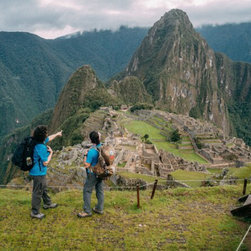
I am not going to over-romanticize this moment because I think you need to experience it for yourself. What I will say is that after 7 hours of hiking, with your lungs working overtime and your legs operating on willpower alone, seeing Machu Picchu spread out below you through the ancient stone doorway of Inti Punku is the kind of moment you do not forget. My group stood there in complete silence for a solid minute. That never happens with us.
From the Sun Gate it is another 45 minutes of downhill trail to reach the hikers-only viewing area just above the citadel. No crowds, perfect photo angles, and the quiet satisfaction of knowing you got here on foot. After about 20 minutes there we headed down to catch the last bus to Aguas Calientes.
Evening in Aguas Calientes
The bus ride from Machu Picchu to Aguas Calientes takes about 20 minutes of winding switchbacks. If you have any tendency toward motion sickness, take something before you board. Your legs are already Jello at this point; the last thing you need is a queasy stomach.
Aguas Calientes is a small mountain town that essentially exists because of Machu Picchu. It is compact, walkable, and surprisingly charming. There is a central plaza, a river running through the middle, an artisan market, and a solid selection of restaurants. After the hike, a big plate of Peruvian food and a well-earned pisco sour felt like the best meal of my life.
Our hotel was clean, comfortable, and had hot water, which after a full day of sweating at altitude felt genuinely luxurious. I slept deeply and completely that night. No tents, no sleeping bags, no altitude wind rattling the sides of a tent. Just a real bed. I cannot overstate how good that felt.
Day 2: The Full Machu Picchu Experience
If Day 1 is the epic hike, Day 2 is the payoff. We woke up early again (5:00 AM is the new normal when you are traveling like this) and caught one of the first buses back up to Machu Picchu. Getting there early is genuinely worth the pain of the early alarm because the morning light on the citadel is stunning and the crowds have not yet arrived.
Our guide led us through a full 3-hour tour of the citadel following Circuit 3, the main route that takes you through all the iconic areas. We visited the Temple of the Sun, the agricultural terraces, the water fountains, the Royal Tomb, the Temple of the Three Windows, and the main plaza. My guide explained the engineering, the astronomy, the social structure, the construction methods, all of it in a way that made the history feel alive rather than like a textbook lecture.
And yes, there are llamas. Several of them just wandering around like they own the place, which honestly they probably do. I took approximately 47 photos of the same llama at slightly different angles. No regrets.
After the guided tour some of our group opted for the Huayna Picchu hike, the steep mountain that rises dramatically above the citadel and appears in every iconic photo of Machu Picchu. It is a tough 2-hour climb and not recommended for anyone with a fear of heights, but those who did it said the view from the top was absolutely worth it.
The rest of us wandered back to Aguas Calientes, had lunch at a restaurant by the river, did some shopping at the artisan market, and boarded the afternoon train back to Ollantaytambo. From there a van took us back to Cusco, arriving around 7:00 PM. Exhausted, sunburned, and completely satisfied.
Permits: The Most Important Thing You Need to Know
Let me be absolutely clear about this: you cannot just show up and hike the Inca Trail. Not the classic version, not the short version, not even just to walk inside Machu Picchu. The Peruvian government has a strict permit-and-guide-only system in place to protect this UNESCO World Heritage Site from over-tourism and erosion.
For the 2-Day Short Inca Trail, only 250 permits are issued per day (total, including guides and support staff). These permits are released months in advance and they sell out fast, especially during peak season from May to October. If you want to hike during those months, start planning at least 5 to 6 months ahead. The trail is also completely closed every February for maintenance.
How to Get Your Permit
The easiest and honestly safest way to get your permit is to book directly through a reputable local tour operator who handles everything for you. I used the 2-Day Short Inca Trail package from Champions Peru Travel, and they took care of the permit, the guide, the train tickets, the hotel in Aguas Calientes, the entrance fees, and even a duffle bag service so I only had to carry a light daypack on the trail. The price is transparent and there are no hidden fees at the checkpoints. For a trip this logistically complex, having a local team in your corner is not a luxury, it is a sanity saver.
Note: You will need to provide your passport details when booking because the permit is tied to your specific passport number. Bring your original passport on the trail. Photocopies and digital copies are not accepted. I kept mine in a Ziplock bag inside my pack all day.
How to Prepare for the 2-Day Short Inca Trail
Preparation for this hike is going to look different for everyone depending on your baseline fitness level, where you live, and how much time you have before the trip. I am not a medical professional so I will just tell you what I did.
I am someone who goes to the gym 4 days a week and focuses mostly on strength training. I consider myself a solid hiker but I live in the Boston area where the highest elevation is maybe 600 feet. High altitude was my biggest concern going in.
I started training specifically for this hike about 3 months out. I kept up the strength training but added a serious cardio component: about an hour on the treadmill every night, 4 nights a week, focusing on high-intensity intervals with steep incline. Not fun. Absolutely worth it.
Acclimatization is Non-Negotiable
I built in 3 full days in Cusco before the hike. I took it very easy those days: short walks around the city, light meals, lots of water, coca leaf tea, and exactly zero alcohol. By the time I laced up my boots for the hike I felt genuinely ready, and the altitude on the trail barely slowed me down.
Preparing for altitude is not optional. It is the single most important thing you can do to ensure you actually enjoy this hike rather than surviving it.
What to Pack
This is a 2-day trip but the trail portion is just Day 1, so you only need to carry a small daypack for the hike itself. Here is what I packed:
Good hiking boots or trail shoes with solid grip and ankle support. Do not wear sneakers. Do not even think about it.
A daypack of about 25 to 30 liters. Lightweight and comfortable with a chest strap.
At least 2 to 3 liters of water. I use a hydration bladder which I cannot recommend highly enough for long hikes. You will sweat out most of what you drink anyway, but stay on top of it.
Rain gear including a waterproof jacket and a pack cover. Even if the sky looks clear in the morning, the cloud forest does what it wants. I put on and took off my rain jacket approximately 5 times throughout the day.
Layers. A moisture-wicking base layer, a light fleece or insulating mid-layer, and your waterproof outer layer. Early mornings on the trail are cold; midday can be warm and humid.
Trekking poles if you use them. My poles saved my knees on the descent. Some people in my group did not use them at all; I would not hike without mine.
Sunscreen and sunglasses. The Andean sun is intense even on cloudy days.
Snacks and lunch. Your tour should include a packed lunch, but bring your own high-protein snacks for the morning section of the hike.
Toilet paper and hand sanitizer. I said what I said. Pack both.
A small trash bag. There are no bins on the trail. Pack out everything you pack in.
Your passport in a waterproof bag.
For Day 2 at Machu Picchu, a light daypack is still all you need. Comfortable walking shoes (your trail boots work fine), water, sunscreen, your camera, and your sense of wonder.
Tips for the 2-Day Short Inca Trail
I have said this multiple times now because it cannot be said enough. Spend at least 2 full days in Cusco before your hike. Your body needs time to adjust to the elevation and there is no shortcut around that.
I am going to keep it real with you: the bathrooms at the Wiñay Wayna rest stop are not for the faint of heart. Find yourself a discreet spot along the trail if you can. Your guide can help you identify appropriate areas. Just do whatever you need to do before you pass the Sun Gate because there are no restrooms inside Machu Picchu. The bus loading area at the bottom has public bathrooms that cost 2 soles, and that is your last option before re-entering civilization.
The Peruvian government shuts down the entire Inca Trail for the month of February every year for maintenance and trail preservation. Do not plan your trip during this window.
Permits sell out months in advance for the May to October season. If you have specific dates in mind, do not wait. Book as early as you possibly can.
The last bus from the Machu Picchu ruins down to Aguas Calientes departs at 5:30 PM. Miss it and you are walking down the mountain on your post-hike Jello legs. Your guide will keep track of time, but stay aware of it yourself too.
One of the great advantages of the 2-day format is that you actually get to experience the town. Walk along the river, browse the market, have a real sit-down dinner, and let the day soak in. It is a genuinely lovely little place and rushing through it would be a waste.
Catch the first or second bus up to Machu Picchu on Day 2. The early morning light is beautiful, the air is cool, and the crowds are manageable. By 10 AM the site fills up considerably and the experience changes.
This is my final tip and it may be the most important one. The correct pronunciation is Mah-choo Peek-choo, which translates to Old Mountain. The incorrect pronunciation, Mah-choo Pee-choo, translates to Old Penis. The locals will absolutely clock you immediately. Say it right.
Final Thoughts
The 2-Day Short Inca Trail is one of the best things I have ever done in my life. I mean that without a single ounce of exaggeration. It is challenging, yes. It requires preparation and planning, absolutely. But walking those ancient stone paths, standing at the Sun Gate with Machu Picchu below you, and then actually spending a full morning inside the citadel learning its history from a knowledgeable local guide - that is an experience that stays with you.
The 2-day format specifically is something I think more travelers should consider over the single-day option. The extra night
Fair warning: I am going to be very honest with you about this hike. That means the good, the ugly, the crying (not mine), and the bathroom situation (also ugly). You deserve the truth.
When planning a trip like this, especially one with strict permit systems and complicated train logistics, I cannot stress enough how much it helps to work with people who actually know what they are doing. I booked my experience through Champions Peru Travel, a local Cusco-based tour operator, and they handled every single detail from the permit to the hotel in Aguas Calientes. I just had to show up and hike. Honestly, it was the best decision I made for this trip.
What is the Inca Trail?
The Inca Trail is one of the most famous hiking routes in the world. It winds through the Andes Mountains in Peru, passes through cloud forests and ancient ruins, and ends at the legendary citadel of Machu Picchu. The classic version starts near Cusco, covers about 26 miles, and takes 4 days and 3 nights with camping along the way.
In Peru, the trail is called Camino Inca, and it has been walked for over 600 years. That fact alone gives me chills every single time I think about it.
What is the 2-Day Short Inca Trail?
For those of us who are short on time, or who have absolutely zero interest in sleeping in a tent at high altitude, there is the 2-Day Short Inca Trail. This version skips the first half of the classic route and picks up at Kilometer 104, covering roughly 12 kilometers (about 7.5 miles) of the most scenic and historically rich section of the original trail.
You hike on Day 1, sleep in an actual hotel bed in Aguas Calientes, and then get a full guided tour of Machu Picchu on Day 2. Two days, two unforgettable experiences. Zero camping. I am sold.
How long is the 2-Day Short Inca Trail?
The hiking portion on Day 1 is approximately 12 kilometers (7.5 miles) and takes between 6 to 8 hours depending on your pace, the stops you make, and how many photos you take (which will be a lot, I promise you). My group took about 7.5 hours including breaks and a proper lunch stop. Day 2 at Machu Picchu is a guided tour of roughly 3 hours inside the citadel, with optional time to explore on your own afterward.
Where does the 2-Day Short Inca Trail begin?
The hike starts at Kilometer 104 along the Urubamba River, near the archaeological site of Chachabamba. And I want to prepare you for this: it is literally just a mile marker in the forest. There is nothing there. No café, no welcome sign, no souvenir stand. Just trees, a river, and a whole lot of trail ahead of you.
To get there, you take the train from Ollantaytambo toward Aguas Calientes and disembark at KM 104. From there you cross a wooden bridge over the river, reach the official checkpoint at Chachabamba, and once your permit and passport are checked, your adventure officially begins.
Where does the trail end?
On Day 1, the hike ends at the Sun Gate, known as Inti Punku, where you get your first aerial view of Machu Picchu below. From there it is another 45 minutes of downhill walking to reach the hikers-only viewing area overlooking the citadel. You will not do the full tour on Day 1; that is what Day 2 is for. After the viewing area, a short walk takes you to the bus loading zone, and a 20-minute bus ride drops you in Aguas Calientes where your hotel is waiting.
How Hard is the 2-Day Short Inca Trail?
Let me be real with you here because I have seen too many blogs call this trail 'great for beginners' and that is simply not true. The 2-Day Short Inca Trail is a moderately challenging hike. The terrain is steep in sections, the stone steps are uneven, and you are doing all of this at elevations ranging from about 2,100 to 2,720 meters (roughly 6,900 to 8,900 feet) above sea level.
The section known as the Monkey Steps will test even experienced hikers. Steep, irregular stone stairs that most people end up climbing on all fours. It is called that for a reason.
My group was a mix of fitness levels. I am a regular hiker and gym-goer, so I found it challenging but manageable. My friend Amanda found it tough but pushed through. My other friend... let us just say there were tears, some creative vocabulary, and a lot of regret, but she finished. And she was proud of herself afterward, as she should have been.
Do not let anyone convince you this is a casual walk. Prepare your body and your mindset.
Altitude is the Real Boss Here
The number one thing that can ruin this experience is not the Monkey Steps, not the weather, and not the bathroom situation (though that is close). It is altitude sickness. Most of Peru sits at a seriously high elevation, and if you arrive in Cusco and try to hike the next day, your body will protest loudly.
The general rule is to arrive at least 2 to 3 days before your hike. Spend that time in Cusco doing light activities, drinking plenty of water, sipping coca leaf tea (widely available and genuinely helpful), and avoiding alcohol. Do not fly directly from Lima to Cusco and head straight to the trailhead. I have seen it happen and I have seen it go very badly.
Walk Me Through the Full 2-Day Experience
Day 1: The Hike
Your day starts absurdly early. My group was picked up from our hotel in Cusco at 4:00 AM for the drive to Ollantaytambo, where we boarded the train to KM 104. By the time we crossed that wooden bridge and got our permits checked, it was around 7:30 AM and the cloud forest was already waking up around us.
The first section of the trail takes you through lush green landscape alongside the Urubamba River. Within the first 30 minutes you reach Chachabamba, an Inca archaeological site nestled in the trees. Your guide will explain the history here and give you time to explore. It is a beautiful introduction to what the day has in store.
From Chachabamba the trail climbs. This is where you start to feel the elevation and the incline. The path winds upward through cloud forest with sweeping views of the river valley below. There are a couple of small mountain huts along the way where you can rest in the shade, but most of the trail is fully exposed so sunscreen is non-negotiable.
Wiñay Wayna: The Highlight of Day 1
About halfway through the hike you cross a bridge over a gorgeous waterfall and arrive at Wiñay Wayna, which translates to 'forever young.' It is sometimes called the little Machu Picchu because of its impressive agricultural terraces and beautifully preserved temple structures.
The climb to the top of Wiñay Wayna is steep and worth every step. The views from up there are, in my personal opinion, the most spectacular of the entire hike. My guide spent a good 20 minutes here walking us through the history and significance of the site, and I could have stayed twice as long.
Just past Wiñay Wayna is a rest stop with bathrooms (I am choosing my words carefully here; prepare yourself mentally), some benches, and a covered hut. This is where my group sat down for lunch. We had made it halfway and the energy in the group was electric.
The Monkey Steps and the Sun Gate
After lunch the trail continues upward to the infamous Monkey Steps: a very steep, very narrow staircase of ancient stones. Most people use both hands and feet to scale this section, which is exactly what the name implies. My poles were absolutely useless here; I just stuffed them in my pack and climbed like the rest of the group.
And then, just past the Monkey Steps, you arrive at the Sun Gate.
I am not going to over-romanticize this moment because I think you need to experience it for yourself. What I will say is that after 7 hours of hiking, with your lungs working overtime and your legs operating on willpower alone, seeing Machu Picchu spread out below you through the ancient stone doorway of Inti Punku is the kind of moment you do not forget. My group stood there in complete silence for a solid minute. That never happens with us.
From the Sun Gate it is another 45 minutes of downhill trail to reach the hikers-only viewing area just above the citadel. No crowds, perfect photo angles, and the quiet satisfaction of knowing you got here on foot. After about 20 minutes there we headed down to catch the last bus to Aguas Calientes.
Evening in Aguas Calientes
The bus ride from Machu Picchu to Aguas Calientes takes about 20 minutes of winding switchbacks. If you have any tendency toward motion sickness, take something before you board. Your legs are already Jello at this point; the last thing you need is a queasy stomach.
Aguas Calientes is a small mountain town that essentially exists because of Machu Picchu. It is compact, walkable, and surprisingly charming. There is a central plaza, a river running through the middle, an artisan market, and a solid selection of restaurants. After the hike, a big plate of Peruvian food and a well-earned pisco sour felt like the best meal of my life.
Our hotel was clean, comfortable, and had hot water, which after a full day of sweating at altitude felt genuinely luxurious. I slept deeply and completely that night. No tents, no sleeping bags, no altitude wind rattling the sides of a tent. Just a real bed. I cannot overstate how good that felt.
Day 2: The Full Machu Picchu Experience
If Day 1 is the epic hike, Day 2 is the payoff. We woke up early again (5:00 AM is the new normal when you are traveling like this) and caught one of the first buses back up to Machu Picchu. Getting there early is genuinely worth the pain of the early alarm because the morning light on the citadel is stunning and the crowds have not yet arrived.
Our guide led us through a full 3-hour tour of the citadel following Circuit 3, the main route that takes you through all the iconic areas. We visited the Temple of the Sun, the agricultural terraces, the water fountains, the Royal Tomb, the Temple of the Three Windows, and the main plaza. My guide explained the engineering, the astronomy, the social structure, the construction methods, all of it in a way that made the history feel alive rather than like a textbook lecture.
And yes, there are llamas. Several of them just wandering around like they own the place, which honestly they probably do. I took approximately 47 photos of the same llama at slightly different angles. No regrets.
After the guided tour some of our group opted for the Huayna Picchu hike, the steep mountain that rises dramatically above the citadel and appears in every iconic photo of Machu Picchu. It is a tough 2-hour climb and not recommended for anyone with a fear of heights, but those who did it said the view from the top was absolutely worth it.
The rest of us wandered back to Aguas Calientes, had lunch at a restaurant by the river, did some shopping at the artisan market, and boarded the afternoon train back to Ollantaytambo. From there a van took us back to Cusco, arriving around 7:00 PM. Exhausted, sunburned, and completely satisfied.
Permits: The Most Important Thing You Need to Know
Let me be absolutely clear about this: you cannot just show up and hike the Inca Trail. Not the classic version, not the short version, not even just to walk inside Machu Picchu. The Peruvian government has a strict permit-and-guide-only system in place to protect this UNESCO World Heritage Site from over-tourism and erosion.
For the 2-Day Short Inca Trail, only 250 permits are issued per day (total, including guides and support staff). These permits are released months in advance and they sell out fast, especially during peak season from May to October. If you want to hike during those months, start planning at least 5 to 6 months ahead. The trail is also completely closed every February for maintenance.
How to Get Your Permit
The easiest and honestly safest way to get your permit is to book directly through a reputable local tour operator who handles everything for you. I used the 2-Day Short Inca Trail package from Champions Peru Travel, and they took care of the permit, the guide, the train tickets, the hotel in Aguas Calientes, the entrance fees, and even a duffle bag service so I only had to carry a light daypack on the trail. The price is transparent and there are no hidden fees at the checkpoints. For a trip this logistically complex, having a local team in your corner is not a luxury, it is a sanity saver.
Note: You will need to provide your passport details when booking because the permit is tied to your specific passport number. Bring your original passport on the trail. Photocopies and digital copies are not accepted. I kept mine in a Ziplock bag inside my pack all day.
How to Prepare for the 2-Day Short Inca Trail
Preparation for this hike is going to look different for everyone depending on your baseline fitness level, where you live, and how much time you have before the trip. I am not a medical professional so I will just tell you what I did.
I am someone who goes to the gym 4 days a week and focuses mostly on strength training. I consider myself a solid hiker but I live in the Boston area where the highest elevation is maybe 600 feet. High altitude was my biggest concern going in.
I started training specifically for this hike about 3 months out. I kept up the strength training but added a serious cardio component: about an hour on the treadmill every night, 4 nights a week, focusing on high-intensity intervals with steep incline. Not fun. Absolutely worth it.
Acclimatization is Non-Negotiable
I built in 3 full days in Cusco before the hike. I took it very easy those days: short walks around the city, light meals, lots of water, coca leaf tea, and exactly zero alcohol. By the time I laced up my boots for the hike I felt genuinely ready, and the altitude on the trail barely slowed me down.
Preparing for altitude is not optional. It is the single most important thing you can do to ensure you actually enjoy this hike rather than surviving it.
What to Pack
This is a 2-day trip but the trail portion is just Day 1, so you only need to carry a small daypack for the hike itself. Here is what I packed:
Good hiking boots or trail shoes with solid grip and ankle support. Do not wear sneakers. Do not even think about it.
A daypack of about 25 to 30 liters. Lightweight and comfortable with a chest strap.
At least 2 to 3 liters of water. I use a hydration bladder which I cannot recommend highly enough for long hikes. You will sweat out most of what you drink anyway, but stay on top of it.
Rain gear including a waterproof jacket and a pack cover. Even if the sky looks clear in the morning, the cloud forest does what it wants. I put on and took off my rain jacket approximately 5 times throughout the day.
Layers. A moisture-wicking base layer, a light fleece or insulating mid-layer, and your waterproof outer layer. Early mornings on the trail are cold; midday can be warm and humid.
Trekking poles if you use them. My poles saved my knees on the descent. Some people in my group did not use them at all; I would not hike without mine.
Sunscreen and sunglasses. The Andean sun is intense even on cloudy days.
Snacks and lunch. Your tour should include a packed lunch, but bring your own high-protein snacks for the morning section of the hike.
Toilet paper and hand sanitizer. I said what I said. Pack both.
A small trash bag. There are no bins on the trail. Pack out everything you pack in.
Your passport in a waterproof bag.
For Day 2 at Machu Picchu, a light daypack is still all you need. Comfortable walking shoes (your trail boots work fine), water, sunscreen, your camera, and your sense of wonder.
Tips for the 2-Day Short Inca Trail
- Acclimatize before you hike
I have said this multiple times now because it cannot be said enough. Spend at least 2 full days in Cusco before your hike. Your body needs time to adjust to the elevation and there is no shortcut around that.
- The Wiñay Wayna bathrooms are truly something else
I am going to keep it real with you: the bathrooms at the Wiñay Wayna rest stop are not for the faint of heart. Find yourself a discreet spot along the trail if you can. Your guide can help you identify appropriate areas. Just do whatever you need to do before you pass the Sun Gate because there are no restrooms inside Machu Picchu. The bus loading area at the bottom has public bathrooms that cost 2 soles, and that is your last option before re-entering civilization.
- The trail is closed every February
The Peruvian government shuts down the entire Inca Trail for the month of February every year for maintenance and trail preservation. Do not plan your trip during this window.
- Book early, especially for peak season
Permits sell out months in advance for the May to October season. If you have specific dates in mind, do not wait. Book as early as you possibly can.
- Do not miss the last bus
The last bus from the Machu Picchu ruins down to Aguas Calientes departs at 5:30 PM. Miss it and you are walking down the mountain on your post-hike Jello legs. Your guide will keep track of time, but stay aware of it yourself too.
- Spend time in Aguas Calientes
One of the great advantages of the 2-day format is that you actually get to experience the town. Walk along the river, browse the market, have a real sit-down dinner, and let the day soak in. It is a genuinely lovely little place and rushing through it would be a waste.
- Go early on Day 2
Catch the first or second bus up to Machu Picchu on Day 2. The early morning light is beautiful, the air is cool, and the crowds are manageable. By 10 AM the site fills up considerably and the experience changes.
- Learn to pronounce Machu Picchu correctly
This is my final tip and it may be the most important one. The correct pronunciation is Mah-choo Peek-choo, which translates to Old Mountain. The incorrect pronunciation, Mah-choo Pee-choo, translates to Old Penis. The locals will absolutely clock you immediately. Say it right.
Final Thoughts
The 2-Day Short Inca Trail is one of the best things I have ever done in my life. I mean that without a single ounce of exaggeration. It is challenging, yes. It requires preparation and planning, absolutely. But walking those ancient stone paths, standing at the Sun Gate with Machu Picchu below you, and then actually spending a full morning inside the citadel learning its history from a knowledgeable local guide - that is an experience that stays with you.
The 2-day format specifically is something I think more travelers should consider over the single-day option. The extra night